
Table of Contents
Introduction to the Forex Market
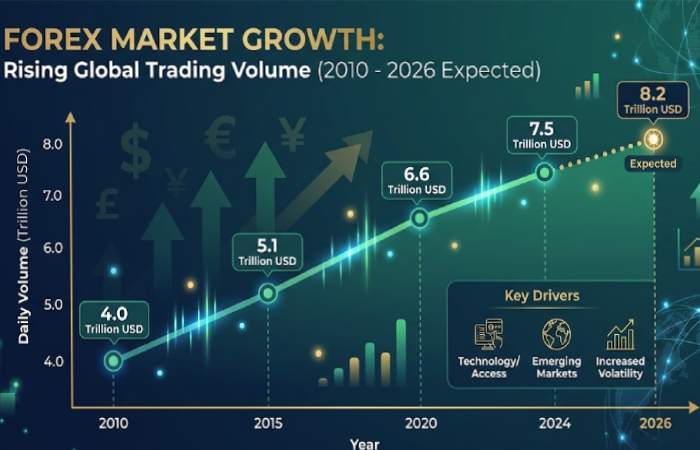
The Forex market (foreign exchange market) is where currencies are traded globally. It is the largest financial market in the world, with a daily trading volume exceeding $7 trillion.
Unlike stock markets, the Forex market operates 24 hours a day, connecting financial centers such as London, New York, and Tokyo.
In simple terms:
You buy one currency and sell another to make a profit from price changes.
Forex Market Growth
How the Forex Market Works
Forex trading happens in currency pairs, like EUR/USD or USD/INR.
- If you think a currency will rise → you buy
- If you think it will fall → you sell
For example:
If you buy EUR/USD at 1.1000 and it rises to 1.1050, you earn profit.
Key Forex Concepts
| Term | Meaning | Why It Matters |
|---|---|---|
| Currency Pair | Two currencies traded together | Core of trading |
| Pip | Smallest price move | Profit unit |
| Spread | Buy & sell difference | Trading cost |
| Lot | Trade size | Risk control |
Types of Forex Markets
Forex isn’t just one system — it has multiple types depending on how trades happen.
- Spot Market → Instant buying/selling
- Forward Market → Future agreement
- Futures Market → Contract-based trading
Forex Market Types Comparison
| Type | Description | Best For | Risk |
|---|---|---|---|
| Spot | Instant trade | Beginners | Medium |
| Forward | Private contracts | Businesses | Medium |
| Futures | Exchange-based contracts | Professionals | High |
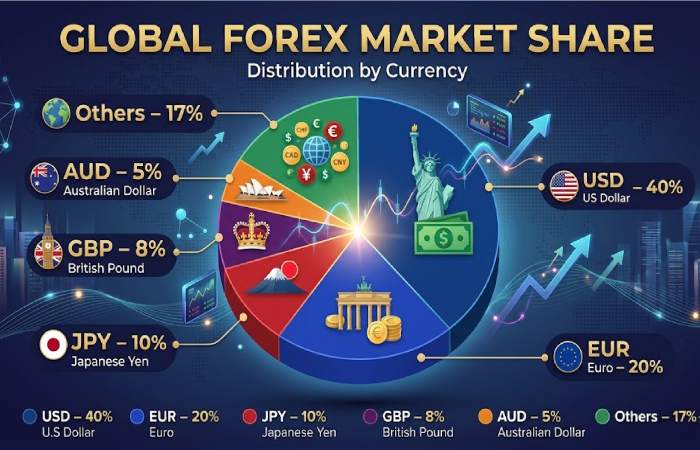
Forex Market Share
Major Currency Pairs in Forex
Not all currencies are equal — some are traded more than others.
- Beginners should always start with stable pairs.
Popular Currency Pairs
| Pair | Volatility | Best For | Note |
|---|---|---|---|
| EUR/USD | Low | Beginners | Most stable |
| USD/JPY | Medium | Scalping | Fast movement |
|
GBP/USD |
High | Experts | Risky but profitable |
| USD/INR | Medium | Indian traders | Regulated |
Who Controls the Forex Market?
The Forex market is not controlled by a single entity. It’s a decentralized system.
Key players include:
- Central banks
- Big financial institutions
- Corporations
- Individual traders
Major Forex Participants
| Type | Role | Example |
|---|---|---|
| Central Banks | Control currency supply | Reserve Bank of India |
| Banks | Execute trades | HSBC |
| Companies | International payments | Apple Inc. |
| Retail Traders | Personal trading | You |
How to Start Forex Trading
Starting Forex is easier than most people think — but doing it correctly matters.
Steps to begin:
- Choose a trusted broker
- Open and verify your account
- Deposit funds
- Start with demo trading
- Move to real trading slowly
Step-by-Step Forex Setup
| Step | Action | Time Required |
|---|---|---|
| 1 | Select broker | 1 day |
| 2 | KYC verification | 1 day |
| 3 | Deposit funds | Instant |
| 4 | Start trading | Same day |
Forex Market Timings
Forex runs 24 hours, but not all times are equally active.
- The best time to trade is when sessions overlap.
Trading Sessions
| Session | Time (IST) | Activity |
|---|---|---|
| Tokyo | 5:30 AM – 2:30 PM | Low |
| London | 12:30 PM – 9:30 PM | High |
| New York | 5:30 PM – 2:30 AM | Very High |
Costs Involved in Forex Trading
Forex looks cheap, but there are hidden costs you must understand.
- Spread (main cost)
- Commission
- Overnight charges
Forex Cost Breakdown
| Cost Type | Range | Impact |
|---|---|---|
| Spread | 0.1–3 pips | High |
| Commission | $0–$10 | Medium |
| Swap Fee | Varies | Low/Medium |
Risk Management in Forex
This is the most important part of trading.
Without risk management → you will lose money.
Key rules:
- Never risk more than 2% per trade
- Always use stop loss.
- Avoid overtrading
Risk Management Tools
| Tool | Purpose |
|---|---|
| Stop Loss | Limit losses |
| Take Profit | Lock gains |
| Leverage | Increase exposure |
Forex vs Stock Market
Many beginners compare Forex with stocks.
Comparison Table
| Feature | Forex | Stock Market |
|---|---|---|
| Hours | 24 hours | Limited |
| Liquidity | Very High | Medium |
| Entry Cost | Low | Higher |
Advantages and Disadvantages
Forex has both opportunities and risks.
Pros & Cons
| Advantages | Disadvantages |
|---|---|
| High liquidity | High risk |
| Easy to start | Needs knowledge |
| Flexible timing | Emotional pressure |
Forex in India
Forex trading is regulated by the Securities and Exchange Board of India.
- Legal with restrictions
- Only INR pairs allowed officially
Common Mistakes Beginners Make
Most traders fail due to simple mistakes:
- Trading without knowledge
- Using high leverage
- Emotional decisions
- No strategy
Note: Avoid these, and you are already ahead of 70% of traders.
Future of Forex Market
The Forex market is evolving rapidly.
- AI-based trading is growing
- Mobile trading dominates
- More retail traders entering
FAQs
What is the Forex Market?
A global market for trading currencies.
Can beginners trade Forex?
Yes, with proper learning and practice.
Is Forex risky?
Yes, but manageable with risk control.
How much money is needed?
You can start with small capital.
Is Forex legal in India?
Yes, under Securities and Exchange Board of India rules.
Learn more at Investopedia
Conclusion
The Forex Market is one of the most powerful financial systems in the world, offering opportunities for both beginners and professionals. However, success depends on knowledge, discipline, and risk management. If you approach Forex with the right mindset and strategy, it can become a strong source of income in the long run.
