
This article belongs to Banking & Corporate Finance
Table of Contents
Introduction
Artificial intelligence has become one of the most transformative technologies in the financial sector. AI-powered financial services refer to the use of machine learning, predictive analytics, and automation tools to enhance banking, investment management, payment systems, and fraud detection.
Leading institutions such as JPMorgan Chase, Goldman Sachs, Bank of America, and Visa increasingly rely on artificial intelligence to process large volumes of financial data and make faster decisions. These technologies improve security, increase efficiency, and help financial institutions provide personalized services to customers.
As fintech continues to evolve, AI is expected to reshape traditional banking models and create new opportunities for businesses, investors, and professionals worldwide.
What Are AI-Powered Financial Services?
AI-powered financial services are financial operations that use artificial intelligence technologies to automate processes, analyze financial data, and improve decision-making.
| Feature | Description |
|---|---|
| Technology | Machine Learning, NLP, Predictive Analytics |
| Purpose | Automation and smarter financial insights |
| Industries | Banking, FinTech, Insurance |
| Main Benefits | Fraud detection, automation, personalized banking |
| Users | Banks, investors, analysts, fintech companies |
To understand where these technologies fit, it helps to first distinguish the organisations using them. Our guide to types of financial institutions outlines the roles of commercial banks, investment banks, credit unions, insurers, and asset managers, each serving different financial needs.
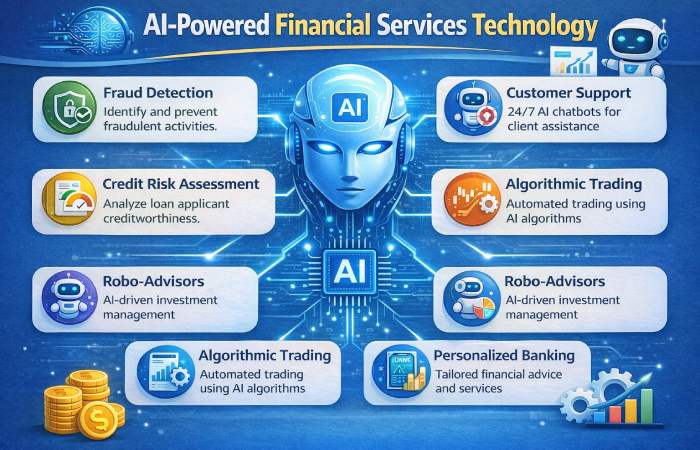
Key AI Technologies Used in Finance
| Technology | Role in Financial Services |
|---|---|
| Machine Learning | Predicts financial trends and credit risks |
| Natural Language Processing | Chatbots and automated support |
| Predictive Analytics | Investment forecasting |
| Robotic Process Automation | Automates repetitive banking tasks |
| Deep Learning | Fraud detection and transaction monitoring |
AI Solutions in Financial Services
Financial institutions implement AI solutions to improve operations and customer experience.
| AI Solution | Description | Example Use |
|---|---|---|
| Fraud Detection Systems | Identify suspicious transactions | Credit card fraud monitoring |
| Algorithmic Trading | Automated trading strategies | Stock market trading bots |
| AI Chatbots | Customer service automation | Banking support assistants |
| Risk Management | Predict financial risks | Loan approval analysis |
| Personalized Finance | AI-driven recommendations | Budgeting tools |
Top AI Tools Used in Financial Services
| Tool / Platform | Provider | Primary Function |
|---|---|---|
| Watson Financial Services | IBM | Financial data analytics |
| Salesforce Einstein | Salesforce | Customer financial insights |
| Kensho AI | S&P Global | Market analysis |
| Zest AI | Zest AI | Credit risk modeling |
| SAS AI Platform | SAS Institute | Fraud detection analytics |
Global Locations Leading AI Financial Innovation
Several cities have become major hubs for AI-driven financial services.
| Location | Country | Known For |
|---|---|---|
| New York | USA | Investment banks and fintech startups |
| London | UK | Global fintech innovation |
| Singapore | Singapore | AI fintech regulation and innovation |
| Bangalore | India | AI and fintech startups |
| Toronto | Canada | AI research and finance technologies |
Websites and Platforms Offering AI Financial Services
| Website / Platform | Service Type |
|---|---|
| https://www.ibm.com | AI financial analytics |
| https://www.paypal.com | AI fraud detection |
| https://www.mastercard.com | AI payment security |
| https://www.kensho.com | AI investment analytics |
| https://www.zest.ai | AI credit scoring |
Pricing Packages for AI Financial Solutions
Many fintech companies provide AI software packages for financial institutions.
| Package Type | Target Users | Approximate Cost |
|---|---|---|
| Basic AI Analytics | Small fintech startups | $500 – $2,000/month |
| Advanced AI Risk Systems | Banks | $5,000 – $20,000/month |
| Enterprise AI Platforms | Large financial institutions | $50,000+/year |
Jobs in AI-Powered Financial Services
AI adoption in finance has created many new career opportunities.
| Job Role | Responsibilities |
|---|---|
| AI Financial Analyst | Analyze financial data using AI models |
| FinTech Developer | Build AI-driven finance applications |
| Quantitative Analyst | Develop trading algorithms |
| Fraud Detection Specialist | Monitor suspicious financial activity |
| AI Risk Analyst | Predict financial risks |
Salaries in AI Finance Careers
| Job Role | Average Annual Salary |
|---|---|
| AI Financial Analyst | $80,000 – $120,000 |
| Quantitative Analyst | $100,000 – $150,000 |
| FinTech Developer | $90,000 – $140,000 |
| AI Risk Specialist | $95,000 – $130,000 |
| Data Scientist (Finance) | $110,000 – $160,000 |
Qualifications Required for AI Finance Careers
| Qualification | Purpose |
|---|---|
| Degree in Finance or Economics | Understand financial markets |
| Computer Science or AI Degree | Develop machine learning models |
| Data Science Certification | Analyze financial datasets |
| Programming Skills (Python, R) | Build AI algorithms |
| Financial Certifications | CFA or fintech certifications |
Technical skills become more useful when paired with an understanding of the business questions behind the data. Studying the core components of corporate finance introduces capital budgeting, funding choices, working capital, and risk management, connecting financial analysis with the decisions companies need to make.
Traditional Finance vs AI-Powered Finance
| Feature | Traditional Finance | AI-Powered Finance |
|---|---|---|
| Data Analysis | Manual | Automated |
| Fraud Detection | Slower | Real-time |
| Customer Support | Human agents | AI chatbots |
| Investment Decisions | Analyst-based | AI-driven models |
| Operational Cost | Higher | Lower |
Pros and Cons of AI-Powered Financial Services
| Pros | Cons |
|---|---|
| Faster data processing | High implementation costs |
| Improved fraud detection | Data privacy concerns |
| Personalized financial services | Risk of algorithm bias |
| Lower operational costs | Requires skilled professionals |
Alternatives to AI-Driven Financial Systems
| Technology | Description |
|---|---|
| Traditional Financial Software | Manual financial systems |
| Rule-Based Automation | Predefined automated processes |
| Human Financial Advisors | Expert decision-making |
| Standard Data Analytics | Basic financial reporting |
Whether analysis uses conventional software or AI, understanding the underlying financial information remains important. An introduction to financial statements and their components explains how businesses report revenue, expenses, assets, liabilities, and cash flows, providing context for interpreting financial data.
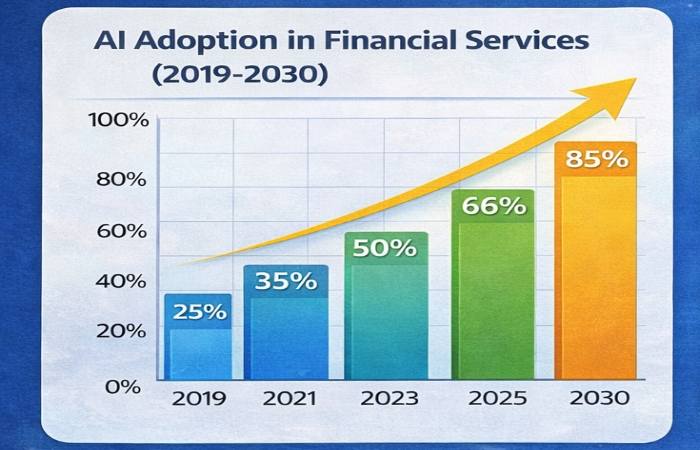
Global Growth of AI in Financial Services
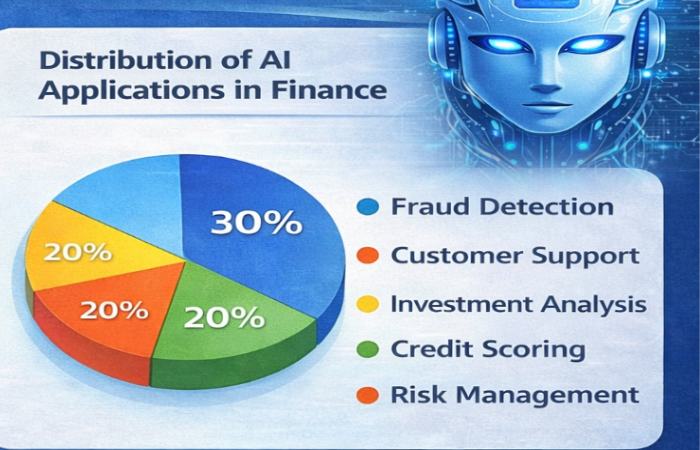
Distribution of AI Applications in Finance
FAQs
What are AI-powered financial services?
AI-powered financial services use artificial intelligence technologies such as machine learning and predictive analytics to automate financial processes and improve decision-making.
How is AI used in banking?
Banks use AI for fraud detection, credit scoring, automated customer support, and predictive financial analysis.
Which companies use AI in finance?
Companies such as JPMorgan Chase, Goldman Sachs, Visa, and Mastercard use AI to enhance their financial systems.
What skills are needed for AI finance jobs?
Professionals typically need knowledge in finance, data science, machine learning, and programming languages like Python.
Is AI the future of financial services?
Yes. AI is expected to play a major role in the future of finance by improving automation, security, and data-driven financial decisions.
Conclusion
AI-powered financial services are transforming the global financial industry by enabling automation, intelligent analytics, and improved security systems. Financial institutions now rely on artificial intelligence to analyze massive datasets, detect fraud, and deliver personalized financial services to customers.
With the continued growth of fintech and AI technologies, the financial sector is expected to become increasingly automated and data-driven. This transformation will not only improve banking efficiency but also create new career opportunities for professionals in finance, technology, and data science.
